What you see
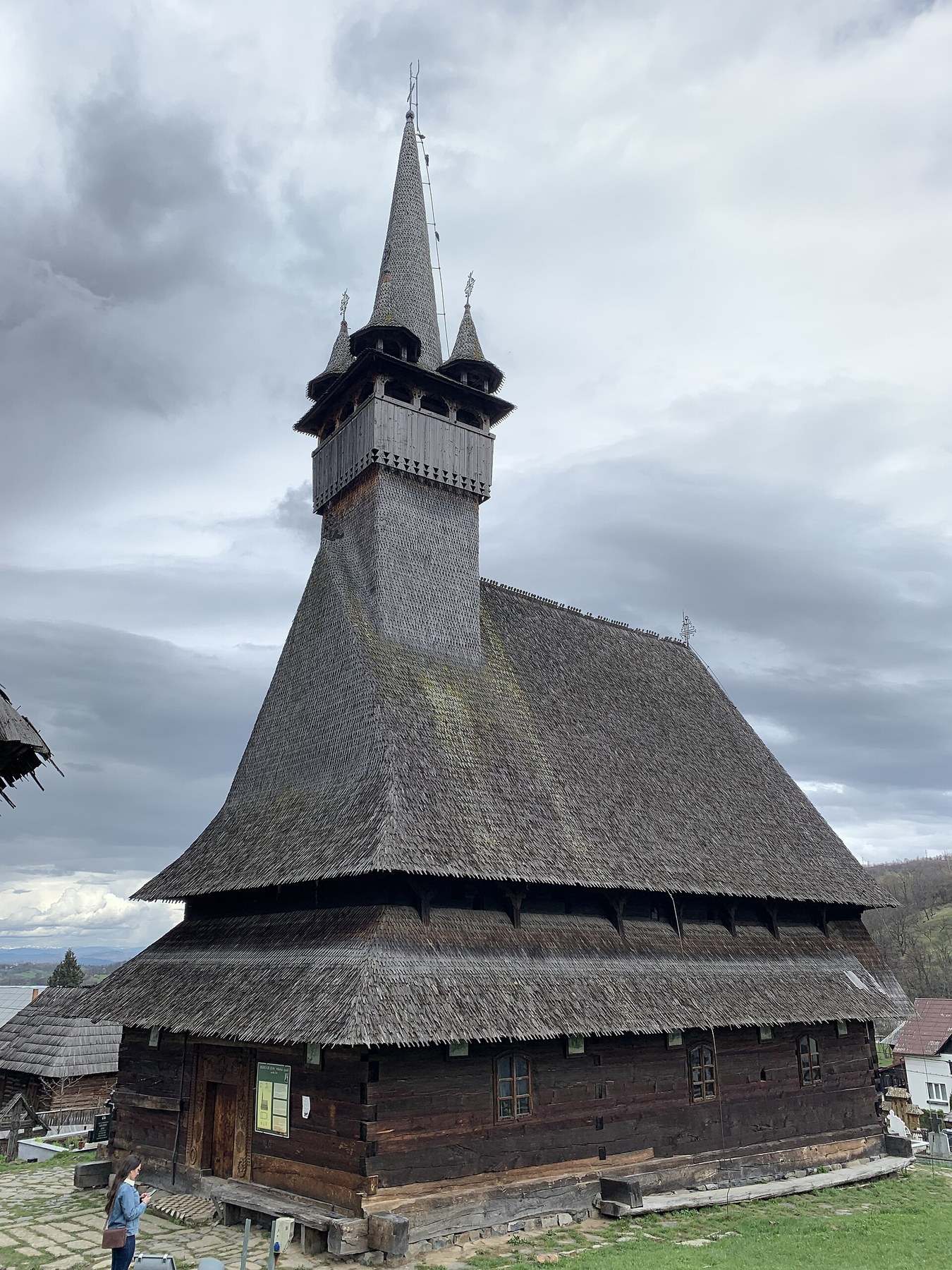
The roof is the first thing you notice: double, very steep, its shingles reaching almost to the ground. Around the main spire stand four small turrets — a rare detail which, in Maramureș, once signalled that the village held the right to pass judgement.
Inside, the walls are covered with paintings from 1762 signed by Alexandru Ponehalschi, one of the painters who worked in several churches nearby. The colours have been dulled by smoke and three centuries of candles, and that is precisely their charm.
The church also keeps the chain-mail shirt of Pintea Viteazul, the outlaw who roamed these mountains in the early 18th century. It is not a story invented for visitors — the piece has been kept here for generations.
How to get there
From the guesthouse you drive down the DJ109F towards Budești, pass the village centre and carry on to the hamlet of Josani. It is 6.7 km, about 7–8 minutes, on tarmac the whole way. The church is visible from the road, on your right, inside a graveyard of old crosses.
You park on the verge, by the graveyard gate. There is no car park, but there are no crowds either — even in summer this place mostly sees small groups.
How long it takes, and what to know
The visit itself takes 20–30 minutes; with the drive there and back, count on an hour. There are no fixed opening hours: the church is usually unlocked by the caretaker or by someone in the village, and there is a service on Sunday mornings.
There is no ticket, but a donation towards upkeep is expected. Photographs inside are normally allowed without flash — do ask whoever lets you in.
Our tips
- Come early in the morning or towards evening: the low light through the small windows brings out the paintings.
- If you want several churches in one day, carry on to Călinești (another 8 km), where there are two more wooden churches.